Best Low-Cost Remote Businesses to Start in 2027

Search for a low-cost business to start from home and you'll find plenty of ideas that technically cost almost nothing.
Freelancing. Affiliate marketing. Virtual assistance. Content creation. Consulting. Dropshipping.
And they're not necessarily bad ideas.
But after nearly two decades of running a business remotely, I've learned that the cheapest business to start isn't necessarily the best business to own.
A $300 freelance business and a $10,000 service business may both be relatively inexpensive compared with opening a traditional business, but they can offer completely different opportunities.
So instead of another list of things you could technically do from a laptop, we're going to look at what different levels of startup capital actually allow you to build.
If you're still comparing your options, see our broader guide to the best remote businesses to start in 2027. Here, we're specifically looking at what your money can actually buy you.
First: What Does “Low Cost” Actually Mean?
There isn't one useful definition.
A freelancer might start with a laptop they already own and spend less than $500. Someone building a small agency may invest several thousand dollars into software, branding, marketing and acquiring clients. A home-based brokerage might require licensing, financial security, training, technology and working capital.
All three can still be relatively low-cost compared with traditional businesses that require commercial real estate, expensive equipment, employees or physical inventory.
That's why I prefer separating two ideas:
Low startup cost means you need very little money to begin.
Low infrastructure means the business doesn't require expensive physical assets, inventory, facilities or equipment to operate and grow.
Those are not the same thing.
A business can cost more to establish while requiring substantially less infrastructure over the long term. And a business that costs almost nothing to start may depend almost entirely on your own time.
I’d rather understand what I’m getting for my investment than simply find the cheapest business I can open.
What Can You Start With Less Than $500?
At this level, your greatest asset usually isn't money.
It's something you already know how to do.
Freelance writing, graphic design, social media management, virtual assistance, tutoring, consulting and certain bookkeeping services can potentially be launched with little more than a computer, basic software and a simple online presence.
Current low-cost-business guides similarly place skills-based services among the least expensive businesses to start because they generally eliminate storefronts and inventory.
That's the advantage.
The disadvantage is that you are often the infrastructure.
If you're a freelance designer and stop designing, production stops. If you're an independent consultant and stop consulting, revenue may stop.
That doesn't make freelancing a bad opportunity. For someone with a valuable existing skill, it may be one of the smartest ways to start generating independent income without risking much capital.
But recognize what you're buying for $500:
In many cases, you've created self-employment, not yet a company that can operate beyond you.
Those can eventually become very different things, but the transition requires systems, customers and usually other people.
What Can You Start With $500 to $5,000?
Now your options expand.
A larger budget can pay for a professional website, software, business formation, branding, prospecting tools, modest advertising and other infrastructure that makes a business look and operate more professionally.
This range can include businesses such as a specialized virtual agency, productized service company, certain e-commerce models and more developed consulting operations.
It can also give you something extremely valuable:
room to acquire customers.
That's one of the startup costs people underestimate.
Building a website doesn't create demand. Forming an LLC doesn't produce a customer. Buying software doesn't generate revenue.
Somebody still has to find you.
When comparing businesses in this range, I'd therefore ask:
Where will the first 10 customers come from?
If you can't answer that question, I'd be reluctant to spend the rest of the startup budget.
What Can You Start With $5,000 to $20,000?
This is the range I find particularly interesting.
You're still nowhere near the capital required for many traditional businesses, but you have enough money to consider opportunities with meaningful barriers to entry.
Depending on the business, that money might cover professional training, licensing, compliance, specialized technology, customer acquisition and enough working capital to launch properly rather than improvising everything.
That's where the conversation changes.
You're no longer asking:
What's the cheapest thing I can start?
You're asking:
What's the strongest business I can build with the capital I actually have?
Those are completely different questions.
And this is approximately where I would place a professionally launched auto transport brokerage, depending heavily on how you choose to build it.
Where Auto Transport Brokerage Fits
This is where I can speak from experience.
I've worked in auto transport since 2008.
An auto transport brokerage isn't a $200 side hustle. I wouldn't market it that way.
But it's also unusual because you can participate in the transportation industry without owning the expensive physical assets normally associated with transportation.
A broker doesn't need to purchase a car hauler.
You don't need a fleet.
You don't need a warehouse.
You don't need to employ drivers to physically move the vehicles.
You don't purchase vehicle inventory.
Instead, the brokerage arranges transportation between customers who need vehicles moved and licensed motor carriers that perform the transportation.
That means your startup money can go toward building the company instead of buying trucks and equipment.
What Are You Actually Paying for?
People sometimes look at startup cost as if every dollar spent before launch is automatically a negative.
I look at it differently.
What does the investment buy you?
With an auto transport brokerage, there are legitimate barriers to entry. Interstate property brokers generally need federal broker authority and appropriate financial security, along with other regulatory requirements. The FMCSA's official broker registration guidance explains the federal requirements.
Beyond compliance, a serious launch may involve business formation, technology, communications, a professional website, marketing, operational tools, training and working capital.
We've broken those expenses down separately in our guide to the cost of starting an auto transport brokerage.
But here's the part I'd pay attention to:
Those requirements create friction.
And friction isn't always bad.
Why an Extremely Low Barrier to Entry Can Work Against You
Imagine two businesses.
Business A costs $150 to start. You can learn the basics over a weekend. No license is required. There are thousands of online tutorials explaining exactly how to do it.
Business B requires several thousand dollars, proper registration, industry knowledge and time spent learning how the operation actually works.
Which sounds easier?
Obviously Business A.
Now ask a different question:
Which one can every other person reading the same “business ideas” article enter tomorrow?
Also Business A.
That's the part of low startup costs that gets less attention.
A low barrier to entry reduces your risk, but it can also reduce everybody else's barrier to competing with you.
A few hurdles to get started aren't necessarily a bad thing.
It doesn't guarantee success. It doesn't eliminate competition. And spending more money certainly doesn't make a business automatically better.
But I wouldn't reject an opportunity simply because it costs $10,000 instead of $500. I'd want to know what that extra investment actually gives me.
The Startup Cost People Forget: Finding Customers
This is one of the biggest lessons I've learned from operating a business.
You can have the licenses.
You can have the website.
You can have the software.
You can know the service inside and out.
And still have no business.
Customers are the business.
This is also where I think prospective entrepreneurs should scrutinize extremely cheap online businesses.
If you're starting an e-commerce store, how will shoppers find your products?
If you're launching a consulting company, why will someone choose you?
If you're selling an online course, where is your audience?
If you're becoming a freelancer, where will your clients come from?
If you're opening an auto transport brokerage, how will people who need vehicles shipped find and trust you?
There's no business model where that question disappears.
The acquisition method changes. The question doesn't.
When budgeting for a business, don't spend every dollar getting ready to operate and leave nothing for actually acquiring business.
A Better Way to Compare Startup Opportunities
Here's the framework I'd use.
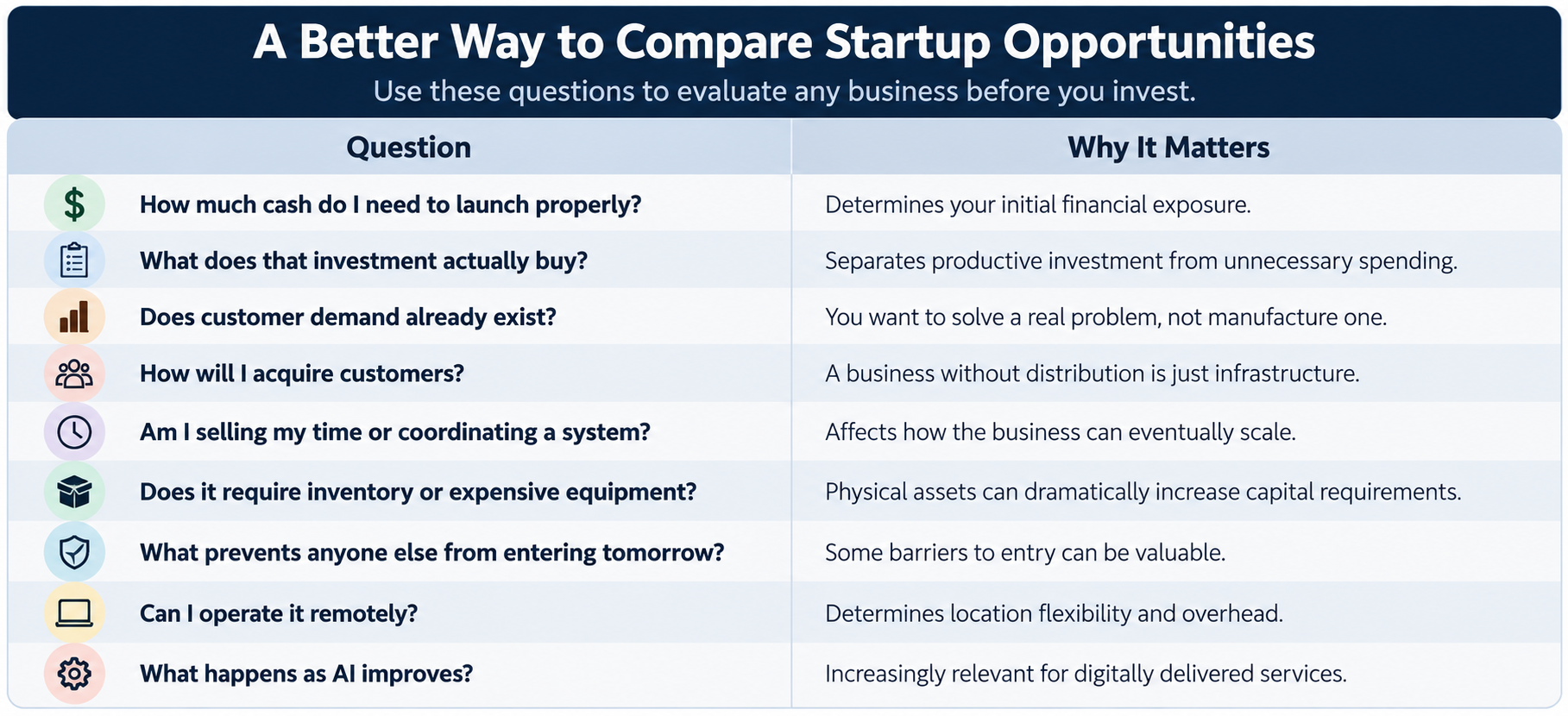
Price belongs in the decision, but I wouldn't let it make the decision for me.
What I Would Want With a $10,000–$15,000 Startup Budget
If I had that amount available to start a business today, I wouldn't feel obligated to spend all of it.
But I also wouldn't automatically choose a $500 business just because I could keep the rest.
I'd look for a model where my available capital gave me some kind of advantage.
Maybe it buys equipment competitors don't have.
Maybe it buys specialized training.
Maybe it gives me enough runway to acquire customers.
Maybe it allows me to enter a regulated industry.
Maybe it funds technology that lets one person operate more efficiently.
Or maybe the right answer really is keeping $14,500 and starting a consulting company for $500 because I already possess expertise people will pay for.
I'd judge the startup cost by what that investment actually gives me access to.
Why I Chose Auto Transport
When I entered auto transport in 2008, I wasn't trying to find the cheapest possible business opportunity.
I wanted something I could actually build.
Nearly two decades later, that's still one of the characteristics I appreciate most about the brokerage model.
It's a business I can operate remotely, but it's connected to something happening in the physical world.
Cars still have to move.
Customers still need quotes.
Carriers still need to be coordinated.
Pickup and delivery schedules still change.
Problems still need to be solved.
And the business can grow without requiring me to purchase the trucks actually transporting those vehicles.
That combination is ultimately what led me to create Auto Transport Academy.
If you want to understand the business itself rather than just the startup cost, read our complete guide to starting an auto transport brokerage.
So, How Much Should You Spend Starting a Remote Business?
As little as necessary.
But not necessarily as little as possible.
If you have $500 and a valuable skill, starting a freelance or consulting business may make considerably more sense than trying to raise thousands of additional dollars for something else.
If you have several thousand dollars and want to build something beyond selling your own time, your options begin to change.
And if you have roughly $10,000–$15,000 available to invest into starting a business, I'd spend much more time evaluating demand, infrastructure, scalability, customer acquisition and barriers to entry than worrying about whether another opportunity could technically be launched for $300.
That's also why I wouldn't describe auto transport brokerage as the cheapest remote business to start.
It isn't.
What makes it interesting is how much traditional business infrastructure it allows you to avoid while still participating in an established, real-world industry.
If you're still comparing your options, head back to our Best Remote Businesses to Start in 2027 guide.
If auto transport is the one you're starting to ask serious questions about, start a conversation with me at Auto Transport Academy.
I'll tell you what getting into the business actually involves, what you should expect to spend, and whether what you're trying to build makes sense.