Best Remote Businesses to Start in 2027

Forget the lists of 50 side hustles. If you want to build an actual business remotely in 2027, these are six business models worth understanding.
Starting a business from home has never been easier
Building one that actually lasts is another story.
Search for remote business ideas and you'll find hundreds of possibilities: dropshipping, freelancing, virtual assistance, affiliate marketing, e-commerce, online courses, content creation and everything in between.
Technically, many of them can make money.
But that's not the question I'd ask before investing my time and money into a business.
I'd want to know:
Is there real demand for what I'm selling? Can the business scale beyond my own time? How difficult is it to find customers? What happens as AI gets better? How much money does it actually take to get started? And am I building a company or simply creating another job for myself?
Those questions narrow the field considerably.
I've operated an auto transport brokerage since 2008. I've watched technology change how we price shipments, communicate with customers, find carriers, market our services and operate the company. But the fundamental business has remained: someone needs a vehicle moved, a carrier has the equipment to move it, and someone needs to coordinate the transaction.
That's one reason I believe auto transport deserves to be part of the remote-business conversation.
But it isn't the only legitimate option.
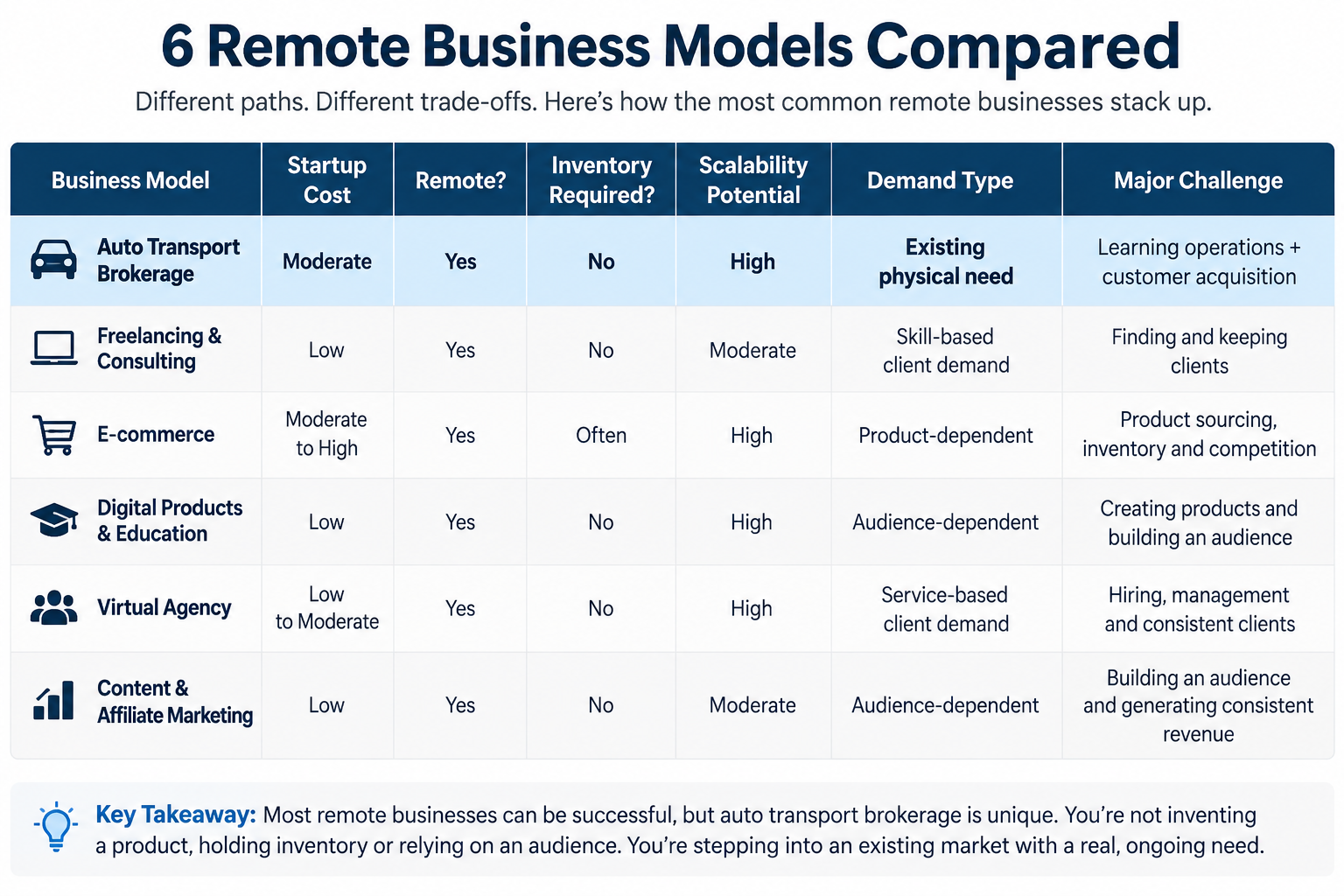
Let's compare six business models based on what actually matters.
What Makes a Remote Business Worth Starting in 2027?
The ability to work from a laptop isn't enough.
In fact, one of the disadvantages of many remote businesses is precisely how easy they are to start. When virtually anyone in the world can offer the same service, competition can quickly become global and price-driven. That's a weakness some current remote-business analyses are beginning to recognize.
I would evaluate a remote business using seven criteria:
Startup cost. How much capital is realistically required before you can operate professionally?
Existing demand. Are people already spending money on the service, or do you have to create demand for something new?
Scalability. Can revenue grow without your personal workload increasing at exactly the same rate?
Customer acquisition. How difficult and expensive is it to find people willing to buy?
Inventory and infrastructure. Do you need products, a warehouse, specialized equipment or a physical location?
AI exposure. Can increasingly capable software perform a meaningful portion of the service customers currently pay humans to provide?
Barrier to entry. Is there anything separating a serious operator from thousands of people who can begin offering the exact same thing tomorrow?
Low barriers aren't always an advantage.
Sometimes a reasonable barrier to entry is exactly what makes a business interesting.
Startup cost deserves a closer look because “low cost” can mean very different things depending on the business. I broke that down separately in my guide to the best low-cost remote businesses to start in 2027, including what different investment levels can realistically allow you to build.
6 Remote Businesses Worth Considering in 2027
1. Auto Transport Brokerage
Startup cost: Moderate
Remote: Yes
Physical inventory: None
Scalability: High
Existing industry experience required: No
Primary challenge: Learning operations and acquiring customers
Auto transport brokerage is one of the more unusual remote businesses on this list because the service itself is decidedly not digital.
Cars physically need to move.
The business of coordinating those moves, however, can largely be operated remotely.
An auto transport broker connects customers who need vehicles transported with licensed motor carriers that can perform the transportation. The broker handles activities such as pricing, customer communication, carrier coordination, scheduling and problem solving.
You don't need to own the truck.
You don't need to drive the truck.
You don't need to store the vehicle.
And you don't need a warehouse full of products.
You are operating the business that coordinates the transaction.
That asset-light structure is one of the things I’ve always liked about brokerage. I went deeper into this in my guide to remote businesses that don’t require inventory, including what each type of business requires in place of physical inventory.
Why There Is Existing Demand
One thing I like about this business model is that you aren't trying to convince the world it suddenly needs a new product.
Vehicles already move across the country every day.
People relocate. Snowbirds move vehicles seasonally. Dealerships buy and sell inventory. Customers purchase cars online. Vehicles move to and from auctions. College students relocate. Military families receive new assignments. Collectors buy cars hundreds or thousands of miles away.
The need already exists.
Your job is to capture a portion of that demand and execute the transportation well.
There Is a Real Barrier to Entry
Auto transport brokerage isn't something you legally establish in five minutes.
Interstate property brokers generally need FMCSA broker authority, a BMC-84 surety bond or qualifying BMC-85 trust fund providing $75,000 in financial security, a BOC-3 filing and the appropriate registration. FMCSA's current application fee for permanent operating authority is $300.
That doesn't mean you simply write a $75,000 check when using a surety bond. But it does mean this is a regulated transportation business, not a casual online side hustle.
I consider that distinction valuable.
Getting the authority is also the easy part.
Knowing how to price a difficult route, acquire customers, select reliable carriers, handle an inoperable vehicle, manage pickup windows, deal with cancellations and protect your reputation is where the actual business begins. That's what experience teaches you.
If you're considering entering the industry, our complete guide to starting an auto transport brokerage walks through the process from the ground up.
2. Freelancing and Consulting
Startup cost: Low
Remote: Yes
Physical inventory: None
Scalability: Moderate
Existing skill required: Usually
Primary challenge: Separating income from your time
If you already possess a valuable skill, freelancing can be one of the fastest ways to create remote income.
Writing, design, bookkeeping, web development, marketing, consulting and dozens of other professional services can be sold with very little startup capital.
The weakness is that many freelance businesses begin with a simple equation:
No work = no billable hours = no revenue.
You can eventually build an agency, hire employees, productize your service or increase your rates. But until then, freelancing can resemble self-employment more than a scalable company.
There is also increasing pressure on some digitally delivered services from both global competition and AI.
That doesn't mean freelancing is disappearing. It means specialized expertise and measurable results are becoming more important than simply being able to perform a task.
Best fit: Someone who already possesses a valuable, marketable skill and wants the fastest route into self-employment.
3. E-commerce
Startup cost: Low to high
Remote: Yes
Physical inventory: Depends on model
Scalability: High
Existing skill required: No
Primary challenge: Products, margins and customer acquisition
E-commerce has enormous potential because sales aren't directly tied to the founder's billable hours.
A successful store can sell ten products or ten thousand.
But "start an online store" is much easier than get people to buy from an online store.
Product selection, suppliers, advertising, fulfillment, returns, inventory and competition can all affect profitability. Even models that remove inventory, such as dropshipping, don't eliminate customer acquisition or fulfillment problems.
That's why I would consider e-commerce highly scalable but operationally more complicated than many opportunity lists make it sound.
Best fit: Someone who understands products, branding and digital customer acquisition and is comfortable testing until they find something the market actually wants.
4. Digital Products and Online Education
Startup cost: Low
Remote: Yes
Physical inventory: None
Scalability: High
Existing skill required: Usually
Primary challenge: Authority and distribution
Digital products have attractive economics.
Build something once and, theoretically, sell it repeatedly.
Templates, educational resources, courses, software tools and specialized information can all become legitimate businesses.
But there is a catch.
You still need someone to buy them.
If you already possess expertise, an audience, search traffic or a strong distribution channel, digital products can be extremely attractive.
Starting with none of those things makes the journey considerably harder.
The barrier isn't creating another PDF or recording another course.
It's giving people a reason to buy yours.
Best fit: Someone with genuine expertise, a differentiated product or an existing way to reach potential customers.
5. Virtual Agency
Startup cost: Low to moderate
Remote: Yes
Physical inventory: None
Scalability: High
Existing skill required: Usually helpful
Primary challenge: Sales and managing people
A virtual agency solves one of freelancing's biggest limitations.
Instead of selling only your own time, you build a company that can deliver services through other people.
Marketing, recruiting, bookkeeping, lead generation, design and other professional services can all operate this way.
The upside is scalability.
The downside is management.
As the agency grows, hiring, training, client retention, quality control and payroll become part of your job.
For someone who enjoys sales and building teams, that isn't necessarily a drawback. It's simply important to understand that you've moved from performing a service to managing an organization.
Best fit: Someone comfortable selling services, managing people and building repeatable processes.
6. Content and Affiliate Businesses
Startup cost: Low
Remote: Yes
Physical inventory: None
Scalability: High
Existing skill required: No
Primary challenge: Building an audience
YouTube channels, websites, newsletters and social accounts can become businesses through advertising, affiliate commissions, sponsorships and products.
The financial barrier to entry can be extremely low.
The time barrier can be enormous.
It may take months or years to build meaningful traffic or an audience, and the business can remain exposed to search engines, social algorithms and platforms you don't control.
That doesn't make content a bad business.
It makes it a particularly poor choice for someone who hates creating content but was told online that it's an easy source of passive income.
Best fit: Someone who genuinely enjoys publishing and is prepared to build an audience over time.
The Question Everyone Should Be Asking in 2027: What About AI?
AI should affect how you evaluate a business in 2027.
But I would be extremely skeptical of anyone promising an "AI-proof business."
There probably isn't one.
AI can already make an auto transport brokerage more efficient. It can help draft communications, organize information, assist with marketing, analyze data and automate administrative work.
I see that as an advantage.
The important distinction is between AI changing how a business operates and AI eliminating the underlying reason the business exists.
A vehicle still needs to physically travel from Miami to New York.
A carrier still needs to transport it.
Pickup and delivery still need to happen.
Customers, dealerships and other shippers still need transportation.
And real-world transportation produces exceptions constantly: timing changes, carrier cancellations, difficult locations, unusual vehicles, customer expectations and pricing changes.
AI will almost certainly change brokerage.
My expectation is that strong brokers will use it to become more efficient rather than pretend it doesn't exist.
That is a very different position from building a business whose primary product is a basic digital task AI can increasingly perform itself.
Is Auto Transport Recession-Proof?
I wouldn't call any business recession-proof. Economic downturns can affect vehicle sales, consumer spending, transportation pricing and the types of customers shipping cars.
But after working in auto transport since 2008, I've also learned that demand doesn't always behave the way you might expect.
COVID was probably the best example I've ever seen.
When the country began shutting down in 2020, you might assume auto transport would have slowed to a crawl. For my business, the opposite happened. I was as busy as I had ever been.
People were moving. Families were relocating. Some people suddenly had the flexibility to live somewhere else because they were working remotely. Others were buying vehicles from different parts of the country. Dealers, auctions and consumers still needed cars transported even while huge parts of everyday life were being disrupted.
The reasons people shipped vehicles changed, but the need to move them didn't disappear.
That experience changed the way I think about the word "recession-proof." I don't believe auto transport is immune to recessions, pandemics or changes in the economy. Rates can move. Certain routes can slow down. One customer segment can become weaker while another becomes stronger.
What I do believe is valuable is the diversity of reasons vehicles need to move.
A customer might be relocating from New York to Florida. A dealer might purchase inventory several states away. A snowbird may need a vehicle moved south for the winter. Someone might buy a car online from across the country. Military families receive new assignments. Auctions move vehicles every day. Collectors buy cars nowhere near where they live.
Those needs don't all rise and fall together.
I've now operated through the 2008 financial crisis, COVID, changing vehicle markets and plenty of ups and downs in between. The business has never remained exactly the same.
The demand shifts. The routes shift. The customers shift. The opportunity shifts with them.
That's why I wouldn't sell auto transport as "recession-proof."
I'd describe it as something I think is far more meaningful: a business built around a physical service that people and businesses continue to need, even when the reasons they need it change.
Why Auto Transport Looks Different From Most Remote Businesses
This is ultimately what makes auto transport interesting to me.
It sits in an unusual middle ground.
You can operate the brokerage remotely, but you're participating in a real-world industry.
You don't need to invent a product.
You don't need a warehouse.
You don't need to manufacture anything.
You don't necessarily need a large team.
You don't need hundreds of thousands of followers.
And your entire business doesn't have to depend on selling your individual hours.
At the same time, there's enough complexity that becoming good at the business actually matters.
Pricing matters.
Sales matter.
Carrier relationships matter.
Communication matters.
Judgment matters.
Customer acquisition matters.
And experience matters.
That's a combination I still find compelling after nearly two decades in the industry.
What Does Running an Auto Transport Brokerage Remotely Actually Look Like?
A typical day might involve responding to new quote requests, speaking with customers, evaluating routes, pricing shipments, posting vehicles, communicating with carriers, scheduling pickups and solving problems with active shipments.
None of that requires you to physically transport the vehicle.
The carrier does that.
The broker manages the transaction.
As volume grows, systems become increasingly important. Quoting, dispatching, customer communication, documentation, carrier vetting and follow-up need repeatable processes.
This is also why I don't call auto transport passive income.
It isn't.
You're building a service business.
The attraction is that the infrastructure required to operate that business can remain relatively lean while the operation itself can grow.
How Does an Auto Transport Broker Make Money?
The basic model is straightforward.
A customer pays for transportation. The carrier performing the transportation receives its agreed carrier pay. The broker earns the difference, from which the broker's operating expenses must still be paid.
Margins vary considerably.
A straightforward shipment might generate a few hundred dollars in gross broker margin. More difficult, enclosed, expedited or specialized shipments can produce larger margins. Some moves will produce less.
For illustration:
5 shipments per week × $200 average gross broker margin = $1,000 per week
At roughly four weeks, that's about $4,000 per month in gross broker margin.
At:
10 shipments per week × $250 average gross broker margin = $2,500 per week
that's roughly $10,000 per month in gross broker margin.
Those are examples, not earnings claims or guarantees. They are also gross broker margin before marketing, software, insurance, bond costs, payroll if applicable, taxes and other business expenses.
Your actual results depend on shipment volume, pricing, carrier costs, routes, customer acquisition and how well you operate the business.
But those examples illustrate something important:
You don't need a million customers.
You're building transaction volume one shipment at a time.
Who Is Auto Transport Brokerage Actually Good For?
I don't think everyone should start an auto transport brokerage.
Someone looking for passive income probably shouldn't.
Someone who refuses to speak with customers shouldn't.
Someone who expects to buy a course and automatically receive a successful business shouldn't either.
But there are traits that translate extremely well.
You may be a good fit if you:
communicate confidently with people
can handle several moving pieces simultaneously
aren't afraid of sales
stay calm when plans change
like solving problems
want to build systems rather than simply sell your time
are willing to learn an industry before expecting it to pay you
You do not need previous auto transport experience.
That's learnable.
What matters more is whether you're willing to become competent at the business you're entering.
Remote Doesn't Mean Passive
This may be the most important thing on this page.
The internet has blurred three very different ideas:
remote work, business ownership and passive income.
They aren't the same thing.
Working remotely simply means your business doesn't require you to be in a particular office.
Owning a business means you're responsible for customers, revenue, expenses, operations and outcomes.
Passive income implies something very different.
A legitimate business generally requires considerable work before it produces freedom.
Auto transport is no exception.
You have to learn.
You have to find customers.
You have to complete shipments.
You have to solve problems.
You have to build relationships.
And you have to improve.
But something interesting happens when you repeatedly solve the same types of problems.
You develop systems.
Then you're no longer figuring out the business from scratch every morning.
You're operating one.
So, What's the Best Remote Business to Start in 2027?
There isn't one answer for everyone.
If you already possess a valuable professional skill and want to begin with almost no capital, freelancing or consulting may make the most sense.
If you understand products, branding and paid acquisition, e-commerce can offer substantial scalability.
If you already have specialized expertise and an audience, digital products can have excellent economics.
If you're strong at sales and management, a virtual agency may be a natural fit.
And if you genuinely enjoy building an audience over time, a content business can become a valuable asset.
But if you're looking for something more unusual, a remote business with existing real-world demand, no physical inventory, relatively lean infrastructure, room to scale and a service that cannot simply become a piece of software, I believe auto transport brokerage deserves serious consideration.
Not because it's easy.
Because it's a real business.
I've been in this industry since 2008, and it's the business that ultimately led me to build Auto Transport Academy.
If you want to understand the industry before deciding whether it's right for you, start with our How to Start an Auto Transport Brokerage guide.
If you've already done the research and you're serious about building one, start a conversation with me at Auto Transport Academy.
ATA was built around real operational experience inside this industry and the systems we've developed from actually moving vehicles, working with customers and carriers, pricing shipments and solving the problems that come with running an auto transport brokerage.
The goal isn't to sell you the idea of working from a laptop.
It's to teach you how to build the business behind it.