Best Remote Businesses That Don’t Require Inventory in 2027

One of the first things I’d want to know before starting a business is where my money is going to be tied up.
I’ve always liked businesses where most of my capital can go toward actually building the company, not buying products, equipment or merchandise that may sit unused.
That’s one reason auto transport brokerage appealed to me. I’ve worked in the industry since 2008 without needing to own the vehicles being shipped or the trucks moving them.
There are other remote businesses you can start without inventory, too. The important question is what replaces the inventory once you remove it.
If you’re still comparing your options more broadly, I put together a complete guide to the best remote businesses to start in 2027.
Why Start a Business Without Inventory?
Inventory changes the economics of a business before the first customer ever shows up.
If you sell physical products, you may need to buy or manufacture them, store them, keep track of them, package them, ship them and deal with returns or damaged merchandise.
There’s nothing inherently wrong with that. Plenty of great companies are built around physical products.
I just think it’s worth asking whether you actually want to be in the inventory business.
With an inventory-free business, more of your startup capital can potentially go toward marketing, technology, training and finding customers instead of sitting on a shelf. It can also make a business easier to operate from home because there’s nothing to store, pack or physically manage.
But removing inventory doesn’t remove the hard part.
You still need something people are willing to pay for.
And depending on the business you choose, what replaces inventory can look very different.
Businesses Where You Sell Your Own Skill
Freelancing and consulting are probably the easiest examples of businesses that don’t require inventory.
A freelance writer, graphic designer, web developer, bookkeeper or marketing specialist doesn’t need products sitting in a warehouse. In many cases, the business can be started with a computer, software and a way to find clients.
For someone who already has a valuable skill, I think that can be a very sensible way to start.
Consulting works similarly, except the customer is usually paying more for your knowledge and judgment than for something you physically produce.
There’s one catch with both models.
You are a big part of what the customer is buying.
If you’re a freelance designer and stop designing, production stops. If you’re an independent consultant and stop consulting, revenue may stop.
That doesn’t make either one a bad business. It just means you’ve replaced physical inventory with your own time, skill or expertise.
And expertise needs to be real.
The internet has made it incredibly easy to call yourself a consultant. It hasn’t made it easy to become someone whose advice is worth paying for.
For someone with years of valuable experience, consulting can be an excellent inventory-free business. For someone starting from zero, there may not be much to sell yet.
Businesses Where You Build a Digital Asset
Digital products, online education and content businesses solve the inventory problem in a different way.
Instead of keeping physical products in stock, you create something digital that can potentially be sold or monetized repeatedly.
That might be a course, template, guide, software tool, paid newsletter, website, YouTube channel or another type of digital resource.
The economics can be attractive.
You don’t need to manufacture another physical unit every time you make a sale. There are no boxes stacked in your garage, and you can potentially serve customers far beyond your local market.
What I wouldn’t assume is that creating the product means you’ve created the business.
You can make the best course in your industry and sell zero copies if nobody knows who you are. You can build a useful website that nobody visits. You can create a great YouTube channel and spend a year trying to build an audience.
Digital products make fulfillment easier.
They don’t make people automatically show up.
I think these businesses make the most sense when you have expertise, an audience, strong search visibility or a realistic plan for reaching the people who need what you’ve created.
If the entire strategy is “I’ll make something and put it online,” I’d want a better plan before investing much money into it.
Businesses Where Other People Deliver the Service
A virtual agency is another way to build a business without inventory, and this is where things start becoming more scalable.
You might own a marketing agency, bookkeeping company, recruiting business, web development company or another specialized service operation.
The customer buys the service from your company, but you don’t necessarily perform every part of that service yourself.
Employees, contractors and systems allow the company to handle more work than one person could complete alone.
I like that model because it starts separating the owner’s time from every dollar of revenue.
But now you have a different set of responsibilities.
You need customers. You need capable people. You need quality control. You need to manage deadlines, communication and margins.
I’ve learned from my own business that adding volume doesn’t simply mean doing more of the same thing. More customers create more communication, more exceptions and more opportunities for something to go wrong.
At that point, good systems become incredibly important.
You’ve avoided inventory, but you’ve replaced it with people and operations.
A Different Kind of Inventory-Free Business
The business model I find most interesting isn’t necessarily one where nothing physical happens.
It’s one where something very physical happens, but I don’t have to own the assets that make it happen.
That’s been my experience with auto transport.
The customer has the vehicle.
The carrier has the truck.
My company brings the two sides together and manages the transaction.
A vehicle might be moving 1,200 miles across the country on an eight-car hauler while I’m running the business from a laptop.
I’ve been able to participate in the transportation industry since 2008 without having millions of dollars tied up in trucks, drivers, maintenance or vehicle inventory.
For me, that’s one of the most attractive parts of the brokerage model.
How Auto Transport Brokerage Works Without Inventory
An auto transport broker arranges vehicle transportation between customers who need cars moved and licensed motor carriers that physically transport them.
The broker doesn’t purchase the customer’s vehicle and resell it.
We don’t manufacture anything.
We don’t need a warehouse.
And we don’t need to purchase a car hauler before we can generate revenue.
Instead, the work is in knowing how to put the shipment together.
I spend my time quoting customers, understanding routes and pricing, finding and vetting carriers, coordinating pickup and delivery, communicating with both sides and dealing with problems when plans change.
And plans do change.
A carrier cancels. A customer gives you the wrong vehicle information. A pickup location turns out to be difficult for a large truck. A route that normally moves easily suddenly gets expensive.
The physical assets belong to other parties, but the responsibility of coordinating everything is very real.
That’s why I wouldn’t describe auto transport brokerage as an easy business just because you don’t need inventory.
You’re replacing inventory and equipment with industry knowledge, sales ability, judgment and operations.
Those things have to be learned.
No Inventory Doesn’t Mean No Investment
This is where people can get the wrong idea about businesses that don’t carry inventory.
No inventory does not mean no startup cost.
An auto transport brokerage has legitimate federal requirements. Interstate property brokers generally need FMCSA broker authority, appropriate financial security and other registrations before operating legally.
The FMCSA’s official broker registration guidance explains those federal requirements.
There are also business formation costs, technology, communications, marketing, training and working capital to consider.
I’ve broken those expenses down separately in our guide to the cost of starting an auto transport brokerage.
If keeping your initial investment as low as possible is your biggest concern, I’d also read Best Low-Cost Remote Businesses to Start in 2027.
That page goes much deeper into what different startup budgets can realistically buy you.
Every inventory-free business still needs something else to create the value.
What Replaces the Inventory?
This is the comparison I’d actually make:
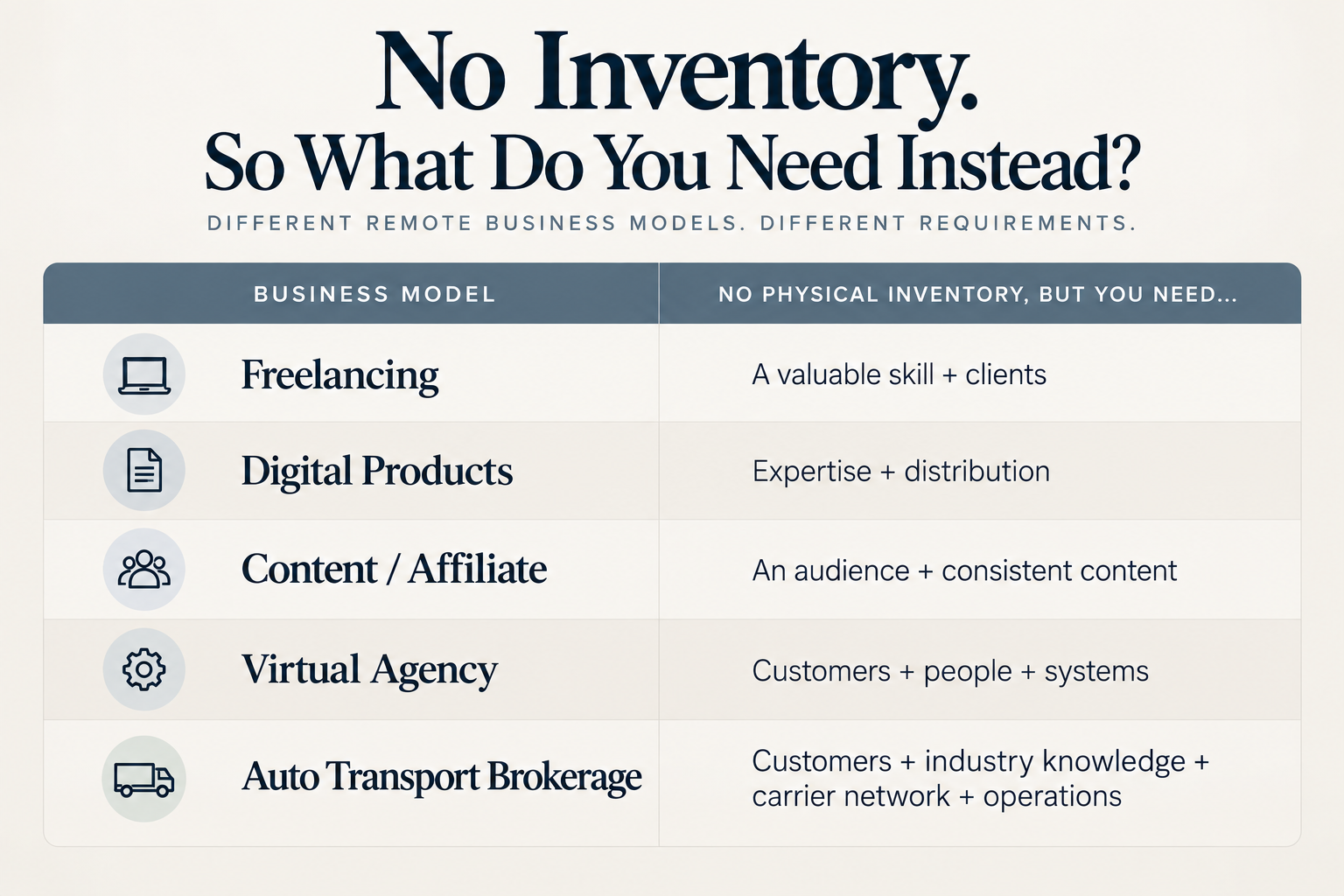
That’s much more useful to me than simply putting a checkmark next to “No Inventory Required.”
Something always has to create the value.
Why No Inventory Can Matter More as You Grow
This is where I think the conversation gets more interesting.
It’s one thing to start a business without inventory. It’s another to grow one without needing substantially more physical assets every time revenue increases.
If I owned a trucking company and wanted to dramatically increase capacity, I might eventually need more trucks, more drivers, more maintenance and more insurance.
If I owned a retail business and sales doubled, I’d probably need more products.
A brokerage works differently.
Growth certainly creates expenses. You may spend more on marketing, software, employees and other parts of the operation.
But I don't need to purchase another $100,000+ truck every time the brokerage reaches another level of shipment volume.
The carriers provide the transportation capacity.
That has allowed me to focus much more of my attention on customers, relationships, pricing and operations rather than acquiring physical assets.
What I’d Look at Before Choosing an Inventory-Free Business
I wouldn’t choose a business simply because there’s nothing sitting in a warehouse.
I’d want to know what replaces the inventory.
If it’s your time, are you comfortable selling your time?
If it’s expertise, do you actually have something people will pay to learn from you?
If it’s an audience, are you willing to spend months or years building one?
If it’s employees or contractors, do you want to manage people?
If it’s learning a specialized industry, are you willing to become genuinely good at it?
And regardless of the model, I’d want an answer to one more question:
Where are the customers going to come from?
You can eliminate inventory, office space and expensive equipment and still fail because nobody knows your business exists.
Why I Still Like the Brokerage Model
After nearly two decades in auto transport, I know enough about the business to know it isn’t for everybody.
There are difficult customers. Carriers cancel. Pickup dates change. Routes get expensive. You have to sell, communicate and make decisions throughout the day.
But I also don’t have millions of dollars tied up in trucks.
I don’t have merchandise that can go out of style.
I don’t have a warehouse lease.
And I can operate the business remotely.
For me, that combination has worked very well.
If you want to understand how the business is actually built, our complete guide to starting an auto transport brokerage walks through it from the ground up.
Auto Transport Academy came later because I wanted to teach the business based on how I’ve actually operated it since 2008, including the parts that aren't obvious when you're looking at the industry from the outside.
If auto transport is one of the businesses you’re seriously considering, start a conversation with me at Auto Transport Academy. I’ll tell you what getting into the industry involves and what I’d want to understand before putting money into it.